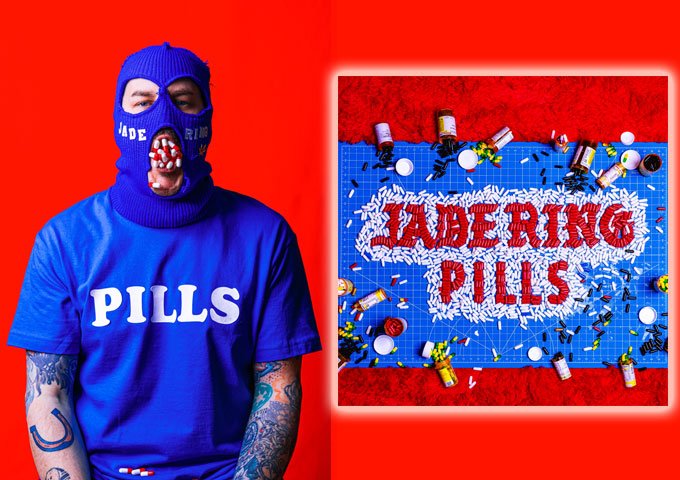
There is something quietly radical about a masked figure stepping forward in an age of algorithmic spectacle to say: this was made by a human. That is precisely what Jade Ring does on “Pills”, his long-awaited debut album released March 15, 2026 on his independent imprint Ghost Laboratories. For a musician with over two decades of writing and recording behind him, across 27 albums and nearly 100 published songs, “Pills” is less an introduction and more an excavation. It is confessional, confrontational, and often thrillingly strange, a five-track, thirty-minute suite that demands to be heard in full and in sequence.
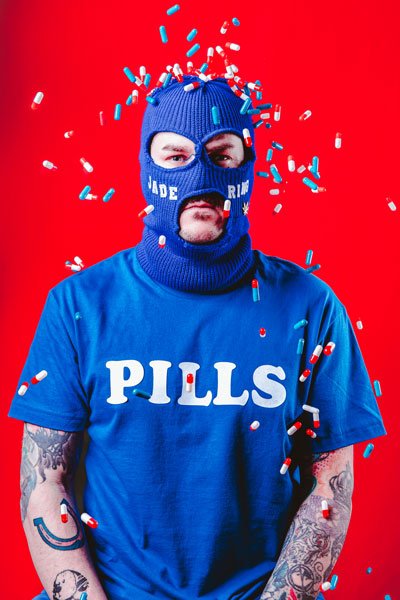
The name Jade Ring is lifted from the mythology of Twin Peaks, where the jade ring serves as a conduit between worlds of light and dark. It is an apt metaphor for someone who has spent much of his adult life navigating the space between breakdown and brilliance, between the analog and the digital, between the person he is and the artist he becomes when he pulls on his mask. The mask itself is a deliberate act of philosophy. In a media landscape where deepfake technology can reconstruct and redistribute a person’s likeness without their consent, the mask becomes an act of resistance, a refusal to be consumed. Jade Ring is also a veteran of the Cleveland music scene, having fronted The Missing and more recently taken up bass duties for award-winning artist ZUP. His label, Ghost Laboratories, was voted best record label at the CleScene Awards in 2011 and now breaks its near-decade of silence with this release.
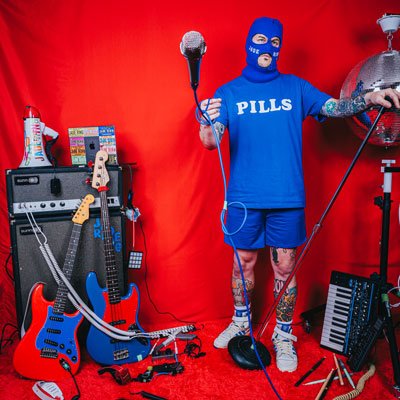
“Pills” was born in a hotel room in Atlanta, Georgia in October 2025, written across three days with nothing but a MacBook and a Keith Macmillan K-Board MIDI controller. It is a remarkably intimate origin story for something that sounds this expansive. Jade Ring performed every instrument himself, recording additional parts at his home studio using exclusively analog instruments, effects, and amplification. Vocals were tracked at Signal Flow Studios and the final mix was handled by Chris DiCola. The influences are audible and eclectic, somewhere between the genre-collapsing chaos of Mr. Bungle and Faith No More, the theatrical pop instincts of Oingo Boingo, the rhythmic intelligence of Battles, the heaviness of Between the Buried and Me, the Cleveland iconography of Mushroomhead and Nine Inch Nails, and the melodic accessibility of 1990s pop and Pink Floyd‘s panoramic ambition. That this record coheres at all is a minor miracle. That it coheres this well is a testament to compositional instinct sharpened over decades.
The album’s thematic core is prescription medication, specifically the complicated, often shameful experience of a man in his forties who resisted pharmaceuticals for most of his life only to find himself dependent on seven separate drugs, each one addressing a condition he spent years refusing to name. Jade Ring has been open about his battles with depression, a devastating period of alcohol addiction in his twenties from which he rebuilt his life from the ground up in 2014, and a formal diagnosis of multiple disorders that arrived only recently after years of intensive therapy. The decision to finally accept prescription medication came weighted with guilt, identity questions, and the peculiar existential vertigo of not quite recognizing oneself in the mirror anymore. “Pills” is where all of that gets processed.
‘Renaissance’ opens the album not with music but with atmosphere and intention. A British and French female voice welcomes the listener, declares the anti-generative AI stance of the project, and invites the audience to settle in with their preferred substance, ideally marijuana, and give the record their full attention. It is a gesture borrowed from an older era of album culture, one that frames everything that follows as deliberate and worthy of sustained focus. The message is clear before a single chord is struck: this is not background music.
‘Brash’ is where “Pills” announces itself most forcefully, and it does so on its own terms. Running over eight minutes without ever resorting to conventional song architecture, the track lurches between late 1990s radio rock and a disco-inflected chorus anchored by an ethereal female opera voice that recurs throughout like a Greek chorus commenting on the chaos below. The name itself was drawn from an Atlanta coffee shop visited during the writing sessions, but its definition, self-assertive, rude, noisy, overbearing, functions just as readily as an artist statement.
Lyrically, ‘Brash’ speaks with disarming directness about the experience of pharmacological dependency, the blurring of identity that comes with feeling chemically managed rather than chemically healed. Lines grappling with whether the medication neutralizes the person alongside the disorder hit with genuine weight. Jade Ring has described one of his prescriptions as producing withdrawal symptoms more debilitating than heroin if a dose is missed, and that visceral reality permeates the song’s most searing passages. The bridge is constructed as a live jam moment, an invitation for audience participation with percussion during future performances, transforming what might otherwise be a deeply private confession into something communal.
‘Coral’ is the album’s most dynamic and perhaps most structurally ambitious piece, a six-minute genre-shifting meditation on apocalyptic thinking and the long, embarrassing history of failed end-of-days predictions. The title is a winking reference to Rick Grimes‘ famously stilted pronunciation of “Carl” in The Walking Dead, a meme artifact from a more innocent internet. But the song’s subtext runs considerably deeper. The slow death of coral reefs worldwide sits alongside references to the 2012 Mayan calendar panic, the COVID-era sense of civilizational collapse in 2020, and the supposed rapture of 2025, all invoked with the dry skepticism of someone who has studied history long enough to recognize its cycles.
Underneath the sardonic framework is something genuinely enraged: the chorus functions as a rallying cry against misinformation, the manufactured consent of dead internet rhetoric, and the silencing of reasonable voices by algorithmic amplification of the absurd. It is a protest song wearing a comedy mask, which makes it hit harder than pure polemic ever could.
‘Ghost Machine’ is the most politically explicit track on the record and arguably its emotional peak. Inspired in part by Jade Ring‘s experience riding driverless Waymo vehicles around Atlanta, the ghost machine of the title becomes a dual metaphor for both the autonomous, soulless car and for generative AI art, which he sees as a machine haunted by the stolen souls of every artist whose work was fed into its training data without consent or compensation. The song opens with sung French verses before expanding into a furious interrogation of what it means to be human in an age when machines are being marketed as creatives.
There are hat-tips to Cleveland’s own Nine Inch Nails and Mushroomhead in the sonic palette, and the French passages function as a love letter to Parisian culture. The song’s most urgent address is directed at Generation Z, who Jade Ring sees as simultaneously the most endangered and most potentially transformative generation, if they can raise their eyes from the screen long enough to act. It is part lament, part rallying cry, held together by a wandering bass line that insists on its own irreducibly human origin.
‘The Bitter End’ closes the album as ‘Renaissance’ opened it, with spoken word in both English and French. It is a moment of genuine warmth after the sustained intensity of everything preceding it, a thank-you to the listener for staying with the record, accompanied by a personal message that brings the whole project back down to the scale of one person speaking honestly to another.
It’s at this point that you begin to understand, that ultimately, “Pills” is an album about control. Control over one’s mind, one’s body, one’s identity, and one’s art. It examines what happens when that control is compromised, whether by internal struggles or external systems. But it also suggests that reclaiming even a fragment of that control is an act of resistance.
“Pills” is available on Subvert, Qobuz, Bandcamp, and Apple Music, platforms selected specifically for their anti-AI artist policies. A physical pressing on compact disc accompanies the digital release, with a limited cassette run to follow, and Jade Ring has expressed hope for a vinyl pressing through Jack White‘s Third Man Records by summer 2026. True to form, pricing will be kept as accessible as possible, with production costs published transparently at jaderingmusic.com.
What Jade Ring has accomplished on “Pills” is rarer than it might initially appear. He has made a genuinely personal record that never collapses into mere self-documentation. He has made a social, cultural and politically aware record that never becomes a lecture. And he has made an album about dependency – chemical and systemic – that leaves the listener feeling more awake rather than more medicated. In an era when music is increasingly something that happens in the background, “Pills” insists on being heard. It rewards that insistence generously.
OFFICIAL LINKS: YOUTUBE – BANDCAMP – APPLE MUSIC – INSTAGRAM