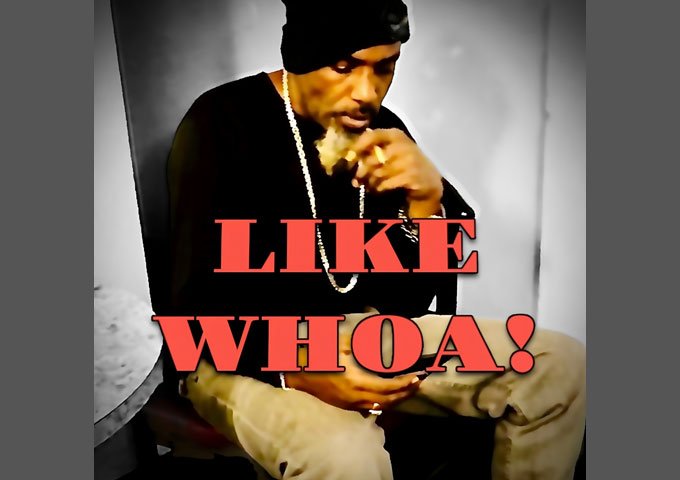
There’s a particular kind of conviction that only comes from having lived the story you’re telling. Freddy Rugga carries that conviction in every bar, and on his single “Like Whoa”, it has never sounded more focused, more urgent, or more alive.
Born Levar Harrison and raised in East Flatbush, Brooklyn during the crack-ravaged chaos of the 1980s and 1990s, Rugga‘s origin story reads like a testament to sheer survival. The neighborhood surrounding Parade Park Playground was a battleground, dominated by the territorial ruthlessness of the Crips, Gangster Disciples, and the Shower Posse, where pitbull fights and turf wars were as routine as the school bell. He arrived into this world carrying what he describes as two strikes before he could walk: being Black and fatherless in an environment that offered precious little mercy for either. Raised by a single mother, he developed what he calls a “Ready to Die” mentality not as nihilism, but as armor. It sharpened him. It made him pay attention to everything.
Perhaps the most quietly devastating detail in his biography is the memory of living in a homeless shelter as a child, when a well-known Harlem rapper, Black Rob, looked him in the eyes and told him he had something special. That moment of recognition, that spark of belief from someone who had made it out, must have felt seismic. Months later, both of them were incarcerated, and two dreams were deferred in the same breath. That kind of proximity to possibility, followed by its sudden collapse, leaves a mark that no amount of time fully erases. But for Freddy Rugga, it also left a blueprint: rise anyway.
That blueprint runs directly through “Like Whoa”. Built on dark, haunting synths that seem to breathe with a life of their own and anchored by a thumping, head-nodding beat laced with skittering hi-hats, the production creates a cinematic tension, the sonic equivalent of walking through a familiar block at night, alert but unafraid. It is the kind of beat that demands you lean in, and Rugga‘s delivery meets that demand with an urgent yet conversational flow that feels rooted in a lineage stretching back to the golden era of New York hip-hop, when Biggie was painting Bed-Stuy in vivid, unflinching detail, and Nas was turning Queensbridge into literature.
Lyrically, “Like Whoa” operates on that same storytelling frequency. Rugga doesn’t simply rap about ambition, he anatomizes it, tracing its origins back through struggle and excavating its emotional cost with the precision of someone who has earned the right to speak on it. The track captures the disorienting feeling of leveling up when the world around you hasn’t moved, the strange vertigo of wanting more than the streets ever promised you while still carrying those streets inside you. It is a meditation on momentum, on the distance between where you started and where you refuse to stop reaching, and it lands with the weight of lived experience behind every syllable.
This is consistent with everything Freddy Rugga has been building. His 2006 mixtape Ruggatime Volume 1 introduced an artist unafraid to document his reality, and his 2016 debut EP Loyalty & Money deepened that commitment, delivering street hustler anthems that resonated because they never flinched. The standout track “LIFE” from that project remains a testament to his ability to translate raw mental toughness into music that moves people, a heavy bassline carrying lyrics that speak directly to anyone grinding against the grain of their circumstances. “Like Whoa” continues that evolution while sharpening its edges, feeling at once more confident and more expansive.
What distinguishes Rugga further is the totality of his creative ownership. A self-produced artist who writes every word he delivers, he has described his relationship with his craft in deceptively simple terms: “#beats made me #rap made me make.” That creative loop, that full-circle mastery, means there is no distance between what he feels and what you hear. The production isn’t decorating the story; it is the story, vibrating at the same frequency as the lyrics.
His movement, Bentley Dreams, extends this ethos beyond music into a lifestyle and philosophy. The name itself is evocative, a symbol of the aspiration to transcend circumstance, to reach for something gleaming and seemingly out of reach while staying grounded in the hunger that makes the reaching possible. It connects his growing community of fans and supporters to something larger than a single release, a shared vision of elevation without apology.
At the heart of all of it is a quote that may be the most honest self-portrait any artist could offer: “I’m just a street dude that wants more than the streets.” In six words, Freddy Rugga captures the essential tension that powers everything he does, the refusal to be defined by the conditions of his beginning while never pretending those conditions didn’t shape him. That honesty is what makes “Like Whoa” more than a record. It is a reckoning, and a declaration. It deserves to be heard loudly.
OFFICIAL LINKS: Follow Freddy Rugga on Twitter: @freddyrugga